
The useful result
Create a change table whose important differences can be traced to both original briefs.
- Create a change table whose important differences can be traced to both original briefs.
A summary can hide the one change that matters. This lesson creates a side-by-side change ledger, then checks the actual passages before you update a project plan. It is useful for handovers, revised creative briefs and team planning—not a legal review.
Google documents file uploads and analysis in Gemini. Available file types and limits depend on the current account. This is an editorial workflow with synthetic examples; we did not run a live comparison for this lesson.
Before you start
- Access to a Gemini account with file uploads available.
- Two short, readable briefs with version labels.
Bring your own attachment
Attach two project briefs you are allowed to share. Name them Version A and Version B and include their dates. Use fictional copies for practice.
Review evidence
Documented hands-on review · 2026-10-07
One observed ChatGPT web run using two fictional briefs; exact model version unavailable. Quoted passages and unchanged requirements manually checked against inputs. This does not establish accuracy on long real documents.
Label the source versions before asking for changes
Use two small briefs. Put a version label and date at the top of each, and confirm both files uploaded. If the PDFs are image-only scans, check that their text is readable; a missed paragraph can look like a removed requirement.
Prepare a comparison checklist: scope, audience, deliverables, deadline and unresolved questions. This bounds the job instead of asking for an open-ended summary.
Example / expected result
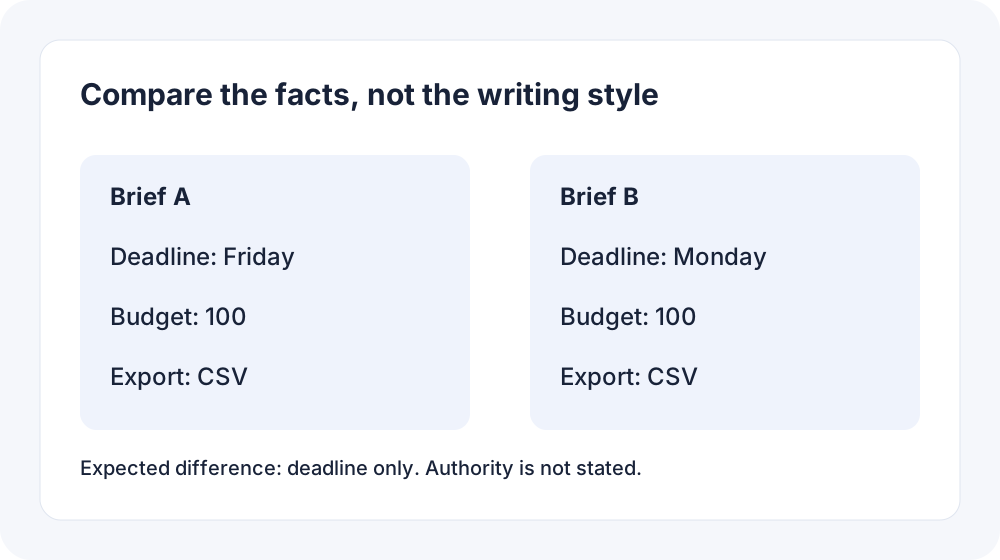
Fictional brief A: launch Friday; budget 100; CSV export. Brief B: launch Monday; budget 100; CSV export. Expected difference: deadline only. Budget and export format remain unchanged. Do not infer which deadline is authoritative without a source.
Check your result
Confirm the correct versions are attached and that each deadline is associated with its own document.
Ask for evidence on both sides
Request a table that distinguishes added, removed and changed requirements. Ask for a source passage from each version. “No change” and “not stated” are useful answers; do not force every row to show a difference.
Compare attached Version A and Version B only.
Return: topic | Version A passage | Version B passage | change | practical impact.
Cover scope, audience, deliverables, deadline and open questions.
Separate explicit changes from your interpretation.
If a detail is absent, write "not stated" instead of guessing.
Do not invent a reason for a change.
Example / expected result
Observed ChatGPT web answer, 7 October 2026: “Launch Friday.” → “Launch Monday.” changed; “Budget 100.” and “Deliverable CSV export.” unchanged. Unresolved decision: Friday versus Monday. All quoted phrases match the fictional briefs; no authoritative version was selected.
Check your result
Open both source passages. Check that they really support the stated difference and that a newer date was not silently assumed to override a different requirement.
Turn only verified changes into a handover note
Mark each row confirmed, disputed or unresolved. Draft the handover from confirmed rows and list unanswered questions separately. A useful note may say “deadline changed; confirm the calendar date” if the briefs only use weekday names.
Keep the source ledger alongside the final note. Someone joining the project later should be able to check why the plan changed.
Using the confirmed change rows, draft a short handover.
Separate required updates from questions needing the project owner's decision.
Do not assign owners or promise dates that the briefs do not state.
Example / expected result
Expected structure: confirmed changes, planning implications, unresolved questions. This is a hand-written target format, not a captured model result.
Check your result
Verify that the final note contains no extra requirement that appeared only in the AI explanation.
When it goes wrong
A long document can be partly overlooked. Compare one section at a time if important details are missing. Conflicting version dates need a human decision. A citation can be wrong: inspect the original passage. Never treat a generated comparison as legal or contractual advice.
Make it your own
Create two fictional 150-word briefs with one added item, one changed date and one unchanged requirement. Run the workflow and check whether all three are represented correctly.
Useful next resources
Sources and review
Last checked Oct 7, 2026. Features and account limits can change. Verify important results against your original material.
Did this help you complete your task?
Tell us what needs improving. No account or private output required.
Report incorrect information or a broken linkGenius Forges Editorial
AI-assisted editorial lessons researched using linked primary sources. Worked examples are illustrative unless a live test is explicitly documented.


