The useful result
Write a one-page proposal draft that separates stated scope, your assumptions and questions for the client.
- Write a one-page proposal draft that separates stated scope, your assumptions and questions for the client.
A proposal that sounds confident can still commit you to work the client never asked for. This lesson uses AI to separate what the brief states from what you are assuming, then drafts a proposal that keeps both visible.
It suits freelancers and small agencies. You set your own prices and timelines; the AI only structures the text.
Reviewed on 10 October 2026. Expected outputs here are illustrative rather than captured AI runs. Account features, limits and wording can differ; keep your original inputs and verify the result before using it.
Before you start
- A client brief or enquiry email with private details removed
- Your own rate and availability, decided by you
Review evidence
Documentation-based review · 2026-10-10
Sources checked on the review date; exercise prompts and expected outputs are original illustrative teaching material.
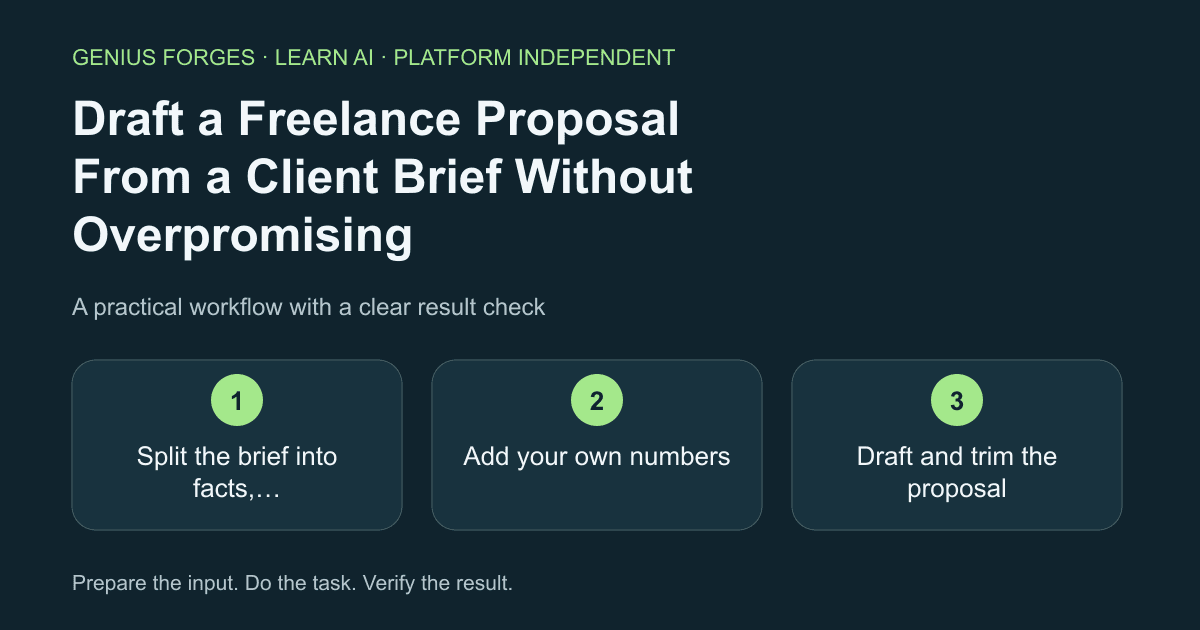
Split the brief into facts, assumptions and questions
Ask the AI to read the brief and sort every point into three lists. A fact must quote the brief. Anything the AI had to guess is an assumption, and anything unclear becomes a question for the client.
Read the client brief below. Return three lists: (1) stated requirements, each quoting the brief; (2) assumptions you would have to make; (3) questions to ask the client. Do not propose prices or dates.

[brief]
Example / expected result
Illustrative example (not a recorded model result): Stated: "five landing page sections". Assumption: copy supplied by the client. Question: how many revision rounds?
Check your result
Each stated requirement can be found word for word in the brief.
Add your own numbers
Fill in your price, timeline and number of revision rounds yourself. These are business decisions, and the AI cannot know your capacity or costs. If you are unsure, write a range and the conditions that move it.
Check your result
Every price and date in your notes came from you.
Draft and trim the proposal
Give the AI the three lists and your numbers, and ask for a one-page proposal. Tell it to keep assumptions in their own section and not to promise outcomes such as rankings, sales or traffic. Read it aloud and delete any sentence you would not say to the client.
Write a one-page proposal using only the lists and numbers below. Sections: scope, what is not included, assumptions, price and timeline, questions. Do not promise business results. Do not add features, guarantees or testimonials.

[lists and numbers]
Check your result
Nothing in the proposal goes beyond your lists, and the "not included" section is present.
When it goes wrong
AI likes friendly guarantees ("we will boost your sales"), so search the draft for result promises and remove them. A proposal is not a contract; for binding terms use your own contract or take professional advice. Tax, VAT and currency treatment differ by country and are not something to take from a chatbot.
Make it your own
Take an old brief you received. Write the three lists, add your own numbers, and compare the new proposal with what you actually sent.
Useful next resources
Sources and review
Last checked Oct 10, 2026. Features and account limits can change. Verify important results against your original material.
Did this help you complete your task?
Tell us what needs improving. No account or private output required.
Report incorrect information or a broken linkGenius Forges Editorial
Practical, documentation-reviewed AI exercises with explicit examples and independent result checks. Examples are illustrative unless a live test is explicitly documented.


