The useful result
Produce a one-page study guide whose key points each match a cited passage in your own sources.
- Produce a one-page study guide whose key points each match a cited passage in your own sources.
Notebook-style tools answer from the documents you add, which makes it easier to check an answer than in a general chatbot. This lesson builds a short study guide from three sources and tests the citations.
Google has been adding features to this product and its naming and plan limits have changed; Product features change quickly; check the tool's own help page for what your account offers today. Some newer abilities were reported for paid tiers only, so this lesson uses basic source-based chat that you should confirm in the product's own documentation.
Google documents the product on its Gemini Notebook help page. Reviewed on 10 October 2026. Expected outputs here are illustrative rather than captured AI runs. Account features, limits and wording can differ; keep your original inputs and verify the result before using it.
Before you start
- Access to Gemini Notebook (NotebookLM)
- Three sources you may upload, such as lecture notes or a chapter
Bring your own attachment
Add up to three sources you are allowed to upload, such as lecture notes, a textbook chapter PDF or a web page. Check the product's help page for accepted file types and limits.
Review evidence
Documentation-based review · 2026-10-10
Sources checked on the review date; exercise prompts and expected outputs are original illustrative teaching material.
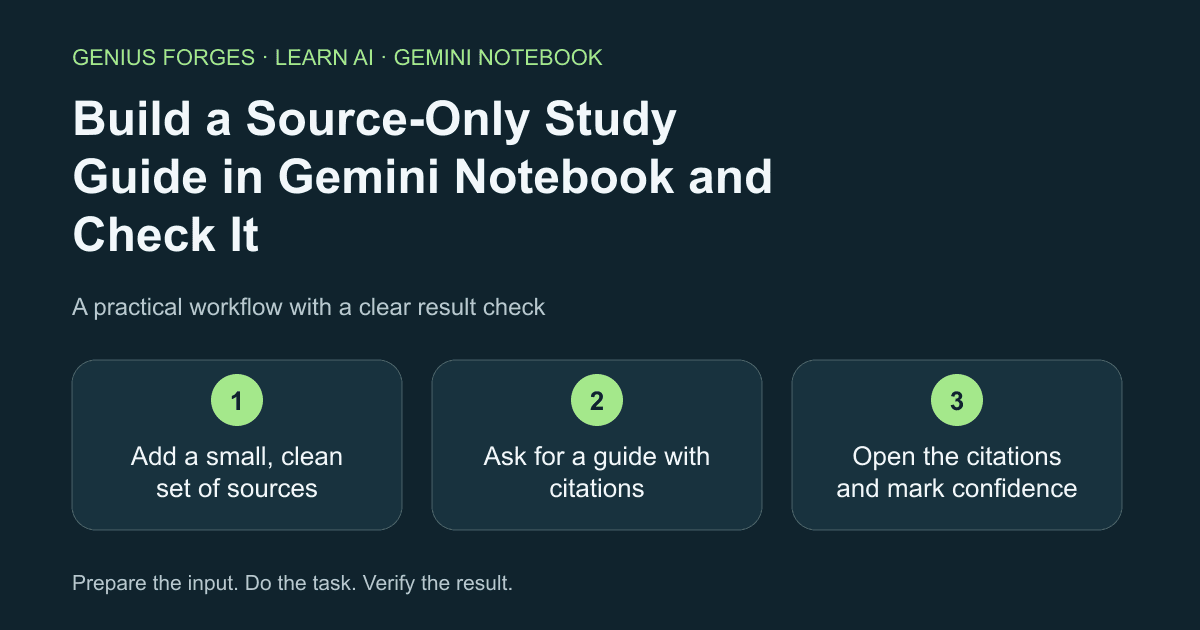
Add a small, clean set of sources
Create a notebook and add three sources on one topic. Rename them clearly. Fewer, relevant sources make citations easier to check than a large pile.
Check your result
The notebook lists exactly the three sources you intended.
Ask for a guide with citations
Ask for a one-page study guide using only the sources, with a short list of terms and likely exam questions. Tell it to say when the sources do not cover a point.
Using only the sources in this notebook, write a one-page study guide: key ideas, five terms with definitions, and three questions I should be able to answer. If the sources do not cover something, say so instead of adding outside knowledge.Example / expected result
Illustrative example (not a recorded model result): Key idea: [statement] with a citation marker pointing to source 2.
Check your result
Each key idea has a citation marker you can click.
Open the citations and mark confidence
Click the citation for at least five points and compare the original passage with the statement. Mark each point confirmed, partly supported or unsupported, and fix the guide. Then quiz yourself from the confirmed points only.
Check your result
Five points are classified and every unsupported point is corrected or removed.
When it goes wrong
A citation shows where text came from, not that the summary is correct; read the passage. If your sources contradict each other, ask which source says what rather than for one answer. Uploaded files may be subject to your school's or employer's rules. Paid-tier features and plan limits can change, so do not assume yours matches a news report.
Make it your own
Use three real sources from a current course. Produce the guide, verify five points, and write one question the sources cannot answer.
Useful next resources
Sources and review
- Google: Gemini Notebook help
- The Decoder: NotebookLM adds a cloud computer per notebook (reported 10 June 2026, paid tiers)
Last checked Oct 10, 2026. Features and account limits can change. Verify important results against your original material.
Did this help you complete your task?
Tell us what needs improving. No account or private output required.
Report incorrect information or a broken linkGenius Forges Editorial
Practical, documentation-reviewed AI exercises with explicit examples and independent result checks. Examples are illustrative unless a live test is explicitly documented.