The useful result
Create a theme table with counts you computed in a spreadsheet and one verified quote per theme.
- Create a theme table with counts you computed in a spreadsheet and one verified quote per theme.
Reviews and survey comments are rich, but AI summaries often say "most customers" with nothing behind it. This lesson uses AI to propose themes, and a spreadsheet to count them, so the final numbers are yours.
You need a small set of reviews or comments you are allowed to analyse, around 20 to 60 for practice. Remove names and any personal data.
Reviewed on 10 October 2026. Expected outputs here are illustrative rather than captured AI runs. Account features, limits and wording can differ; keep your original inputs and verify the result before using it.
Before you start
- 20 to 60 anonymised reviews or survey comments
- A spreadsheet application
Optional attachment
Use a CSV or pasted list with one review per row and an ID number in the first column. Remove names, emails and order numbers first.
Review evidence
Documentation-based review · 2026-10-10
Sources checked on the review date; exercise prompts and expected outputs are original illustrative teaching material.
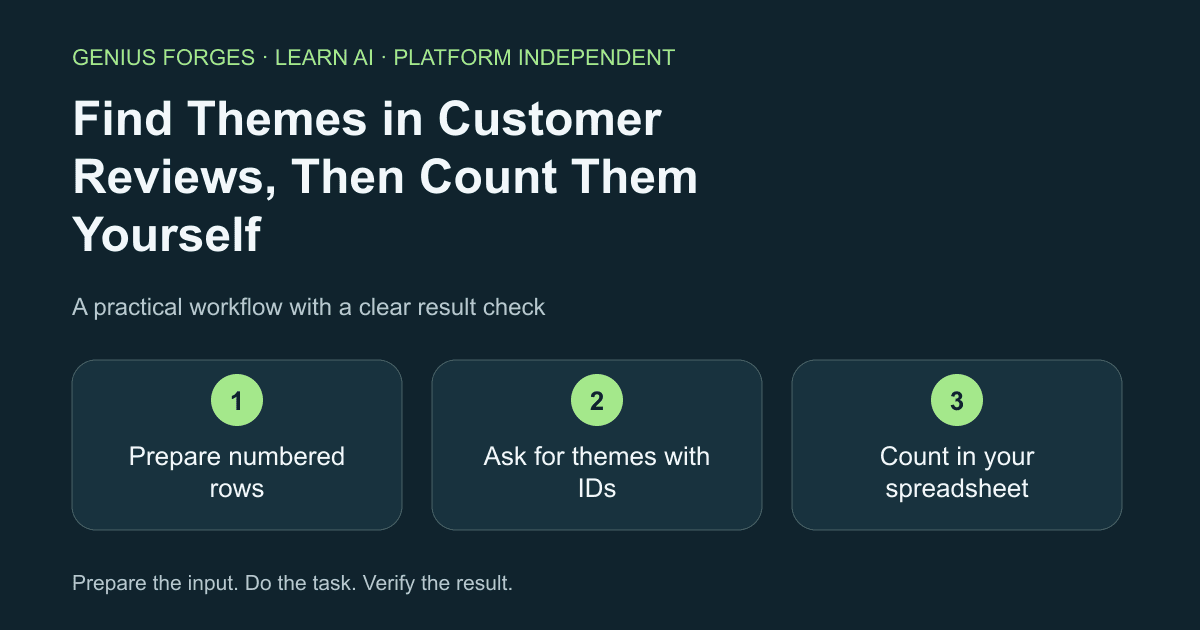
Prepare numbered rows
Put one review per row with an ID. Delete personal data. If you have more than the tool can read, split into batches and keep the IDs unique across all of them.
Example / expected result
Illustrative example (not a recorded model result): ID 1: "Delivery was late but support fixed it." ID 2: "Great quality, box damaged."
Check your result
Every review has a unique ID and no personal data.
Ask for themes with IDs
Request three to six themes. For each theme, ask for the list of review IDs it covers and one exact quote. Ask it to say when a review fits no theme. Do not ask for percentages.
Group these numbered reviews into three to six themes. For each theme return: name | review IDs | one exact quote with its ID. List IDs that fit no theme. Do not give percentages or totals.

[reviews]
Example / expected result
Illustrative example (not a recorded model result): Theme: delivery delays | IDs 1, 7, 12 | "Delivery was late but support fixed it." (ID 1).
Check your result
Open three quoted IDs and confirm the quote is exact and fits the theme.
Count in your spreadsheet
Add a theme column, fill it from the AI's ID lists, then use a COUNTIF or pivot table to count. Look at the rows without a theme and fix any review the AI put in the wrong group. Report counts as "X of N reviews sampled", not as a market-wide claim.
Example / expected result
Illustrative example (not a recorded model result): Illustrative sheet result: delivery delays 3 of 40 reviews, damaged packaging 5 of 40, unthemed 4 of 40.
Check your result
Theme counts plus unthemed rows add up to the total number of reviews.
When it goes wrong
A sample of reviews is not your whole customer base; people with strong opinions are more likely to write. AI can double-count a review that mentions two themes, so decide whether a row may have more than one. Sentiment labels are guesses; read the borderline ones. Make sure you may analyse the reviews under the platform's terms.
Make it your own
Use 30 anonymised comments from a form or survey you run. Produce the themes, count them yourself, and note one review the AI grouped incorrectly.
Useful next resources
Sources and review
Last checked Oct 10, 2026. Features and account limits can change. Verify important results against your original material.
Did this help you complete your task?
Tell us what needs improving. No account or private output required.
Report incorrect information or a broken linkGenius Forges Editorial
Practical, documentation-reviewed AI exercises with explicit examples and independent result checks. Examples are illustrative unless a live test is explicitly documented.


