The useful result
Review multiple product-angle concepts using the same visible-detail contract.
- Review multiple product-angle concepts using the same visible-detail contract.
A product can look attractive in three images while quietly changing shape between them. Give the image model a fixed reference and an invariant checklist, then review each requested view against it. Nano Banana 2.1 supports reference-led image workflows; that capability does not make an unseen side a verified reconstruction.
Use a supported image-generation interface; model choice, reference support and output settings depend on the account. You can practise the technique on the supplied fictional inputs with an available compatible assistant first. This lesson is documentation-based; examples are expected results, not a claim that we ran the named model.
Before you start
- A product photo you own, preferably showing the important geometry.
- A short invariant list and permission to generate derivative concept images.
Bring your own attachment
Attach the permitted product photo in a supported image-generation interface. If you have real side and back photos, label them separately; do not imply an unseen view was supplied.
Review evidence
Documentation-based review · 2026-10-18
Provider documentation checked on 18 October 2026. Examples and checks are original illustrative exercises, not recorded platform tests. Cover artwork is conceptual and does not imply provider sponsorship.
List what must stay the same
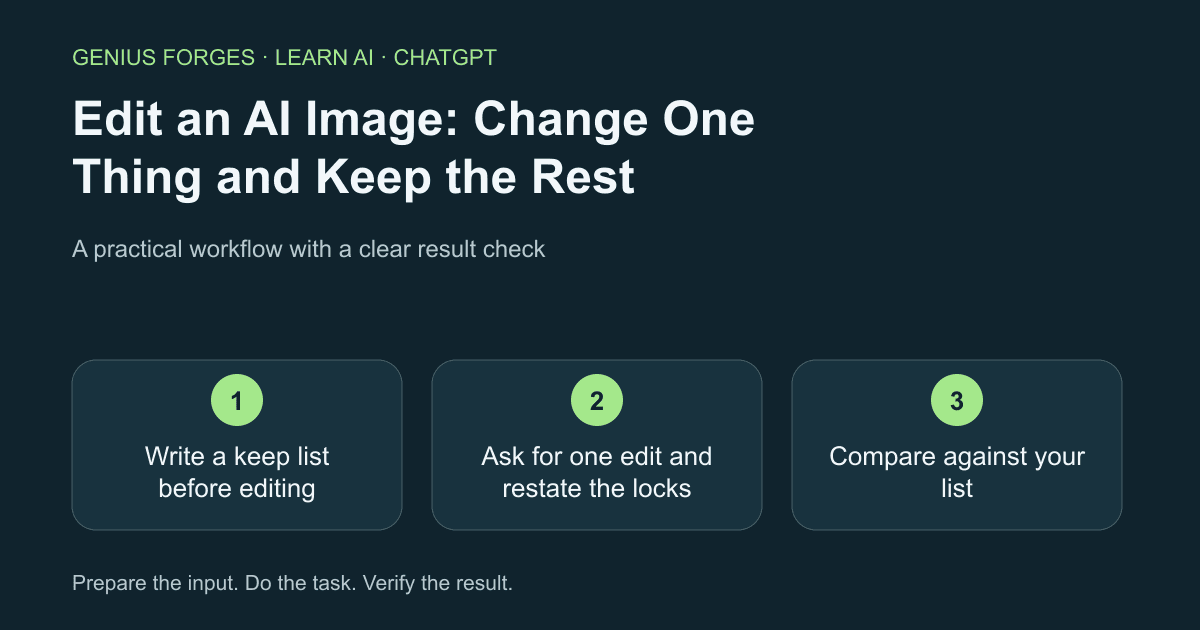
For a fictional mug, note sage glaze, one round handle, a straight rim and a cream base ring. Distinguish visible features from hidden surfaces. Keep the source image unchanged as the anchor for every attempt.
Example / expected result
Illustrative example; not a recorded model result.
Invariants: one handle; no logo; sage body; cream base ring. Rear-side surface: not documented.
Check your result
Each invariant can be checked against a real supplied reference.
Change only the viewing direction
Request one new angle at a time while preserving the detail contract. If the platform supports references, supply the same anchor and identify each image’s role. Use the interface’s actual size settings rather than expecting “4K” text to configure them.
Use my attached product as the identity reference. Create a three-quarter-view concept of the same mug. Preserve sage glaze, one round handle, straight rim and cream base ring. Add no logo, seam or accessory. Keep neutral studio light. If a hidden surface is not documented, make only a simple concept and do not claim a measured reconstruction.Example / expected result
Illustrative example; not a recorded model result.
Expected review table: body color MATCH; handle count MATCH; base ring MATCH; hidden rear details UNVERIFIED.
Check your result
The generated view is labelled a concept and does not claim to reveal the real hidden surface.
Inspect a side-by-side contact sheet
Compare source and candidate at the same display scale. Check silhouette, handle attachment, material, marks and count of parts. Reject a view that changes the object even if it looks more polished. Label accepted images as AI-generated concepts where appropriate.
Check your result
All accepted views pass visible invariants and retain an explicit hidden-surface limitation.
When it goes wrong
Multi-view image consistency is not a 3D model or a guarantee of product truth. Do not invent a product logo, safety feature or working mechanism. If selling an actual item, use accurate real product photography for claims the concept cannot establish.
Make it your own
Generate a second view with the same checklist. Have another person identify any changed handle shape without telling them which image you preferred.
Useful next resources
Sources and review
Last checked Oct 18, 2026. Features and account limits can change. Verify important results against your original material.
Did this help you complete your task?
Tell us what needs improving. No account or private output required.
Report incorrect information or a broken linkGenius Forges Editorial
Practical AI lessons with checked sources, labelled examples and human verification.